Showing posts with label Marketing. Show all posts

Saturday, February 16, 2013

Mortgage Market Guide Weekly Issue 7

Last Week in Review: There was another sign that the housing market continues to recover. Plus, chatter about the Fed.

"Ease on down the road." The song from the musical The Wiz could also apply to recent chatter in the markets, regarding whether the Fed will continue to "ease on" with their Bond buying program, known as Quantitative Easing. Read on for details and what they mean for home loan rates.

Quantitative Easing is the concept of the Fed becoming a buyer of Treasuries and Bonds to try and stimulate the economy. Oftentimes, the Fed does Quantitative Easing when they are hoping to (1) create inflation and avoid a deflationary economy, (2) lower the unemployment rate, and (3) boost Stock prices.

Over the last few months, the Fed has bought large amounts of Mortgage Bonds through their Quantitative Easing program to keep home loan rates (which are tied to Mortgage Bonds) near record lows, and to help strengthen our housing market and economy overall. And the housing market has definitely seen some improvement. Last week, the National Association of Realtors reported that the national median existing single-family home price surged 10% since this time last year to $178,900. The year-over-year increase of 10% was the largest gain since the fourth quarter of 2005.

This is one of the big reasons the Fed will likely continue their Quantitative Easing program: The housing market is on the mend and stopping the program could threaten the housing recovery.

So what is the bottom line? Stocks continue to do well--at the expense of Bonds and home loan rates. However, the debt crisis continues in Europe: Spain, Italy and Greece remain in contracting economies and now France and Germany have shown negative GDP growth that was even worse than expected. This means that investors will likely continue to see our Bond market as a safe haven for their money, which could ultimately benefit Bonds--and home loan rates, which are tied to Mortgage Bonds--in the process.

The biggest take away is that home loan rates remain near historic lows, making now a great time to consider a home purchase or refinance. Let me know if I can answer any questions at all for you or your clients.

Forecast for the Week: The markets are closed Monday for Presidents' Day, but important housing and inflation news will be released later in the week.

The markets are closed Monday in observance of the Presidents' Day holiday, but look for several important reports later in the week.
  • Housing news hits the wires, with Housing Starts and Building Permits on Wednesday and Existing Home Sales on Thursday.
  • We'll get a double dose of inflation news with Wednesday's wholesale-measuring Producer Price Index, followed by the Consumer Price Index on Thursday.
  • Also on Thursday, Initial Jobless Claims and the Philadelphia Fed Index will be reported.
In addition, the minutes from the January meeting of the Federal Open Market Committee will be released on Wednesday at 2:00pm ET. With all the differing opinions of the Fed governors and the chatter about Quantitative Easing, this has the potential to move the markets.

Remember: Weak economic news normally causes money to flow out of Stocks and into Bonds, helping Bonds and home loan rates improve, while strong economic news normally has the opposite result. The chart below shows Mortgage Backed Securities (MBS), which are the type of Bond that home loan rates are based on.

When you see these Bond prices moving higher, it means home loan rates are improving -- and when they are moving lower, home loan rates are getting worse.

To go one step further -- a red "candle" means that MBS worsened during the day, while a green "candle" means MBS improved during the day. Depending on how dramatic the changes were on any given day, this can cause rate changes throughout the day, as well as on the rate sheets we start with each morning.

As you can see in the chart below, Bonds and home loan rates have been impacted by the rally in Stocks. However, home loan rates remain near record lows and I'll continue to monitor them closely.

Chart: Fannie Mae 3.0% Mortgage Bond (Friday Feb 15, 2013)

View: Thinking less may actually help you get more done. Check out why below.

Rituals of Success
How to Get More Done By Thinking Less


If you've ever felt like you can't find time to get to your list of important things, you're not alone. New York Times best selling author Tony Schwarz says almost 75 percent of workers around the world feel disengaged at work and that the "more, bigger, faster" mantra is to blame. We are busier than ever, trying to get more done with fewer resources.

Schwarz suggests everything we do--whether checking email, exercising, or resisting the temptation to eat an extra cookie--often requires thinking, and thinking takes energy. So, if you want to get more done you must actually think less.

In 1911, philosopher A.N. Whitehead wrote: "It is a profoundly erroneous truism that we should cultivate the habit of thinking of what we are doing. The precise opposite is the case. Civilization advances by extending the number of operations we can perform without thinking about them."

The answer, according to Schwarz, is to make important things automatic, what he calls a ritual. Rituals are highly specific behaviors performed at a specific time. He reports the five rituals that have made the most difference in his life are:
  1. Sticking to a bedtime that ensures he gets at least 8 hours of rest.
  2. Working out first thing in the morning, whether he feels like it or not.
  3. Starting his workday by doing the most important task first--decided the night before--and working only in 90-minute time blocks with a definite break in between.
  4. Writing down his good ideas immediately, so they aren't bouncing around in his mind all day, or worse, forgotten entirely.
  5. When upset by someone or something, he ritually asks how he can see the same set of facts in a more hopeful or empowering way.
Remember, the less you have to think about your goals as you perform the steps to achieve them, the more likely you are to check them off your list.

Economic Calendar for the Week of February 18 - February 22

The material contained in this newsletter is provided by a third party to real estate, financial services and other professionals only for their use and the use of their clients. The material provided is for informational and educational purposes only and should not be construed as investment and/or mortgage advice. Although the material is deemed to be accurate and reliable, we do not make any representations as to its accuracy or completeness and as a result, there is no guarantee it is without errors.

As your mortgage professional, I am sending you the MMG WEEKLY because I am committed to keeping you updated on the economic events that impact interest rates and how they may affect you.

Monday, January 21, 2013

Mortgage Market Guide Weekly Issue 3

Last Week in Review: There was good news on the housing front, plus inflation remains tame.


"There is magic in that little word, home." Robert Sotheby. And last week, there were more signs that the housing sector continues to improve. Read on for details.

Housing Starts surged by 12.1% in December to 954,000 units on an annualized basis. This was above expectations and the highest level since June 2008. Building Permits, a sign of future construction, also increased, coming in slightly higher than the November reading.

In addition, research firm CoreLogic reported that home prices rose by 7.4% in the year ended in November. This figure, which includes the sales of distressed properties, was the largest year-over-year increase since 2006 and it has been positive for nine straight months. Also, the Obama Administration's December Housing Report showed that home prices had solid annual gains for the year ended in October, with the Federal Housing Finance Agency (FHFA) and Case-Shiller housing price indices up 5.6% percent and 4.3%, respectively, from one year ago.

It's also important to note that RealtyTrac's year-end 2012 foreclosure report showed that foreclosure activity increased in 25 states. However, median home prices also increased in 25 states, which pulled 1.6 million homeowners out of negative equity in 2012.

So what's the takeaway? Goldman Sachs has reported that the fundamentals are pointing towards larger gains for housing prices in the next couple of years. And with home loan rates remaining near record lows, great opportunities are available.

As always, one thing that's important to monitor is inflation. Since inflation reduces the value of fixed investments, inflation is considered the arch enemy of Bonds–and, therefore, of home loan rates, which are tied to Mortgage Bonds. However, last week's wholesale-measuring Producer Price Index and the Consumer Price Index showed that inflation remains tame, meaning inflation is not a factor at this time.

The bottom line is that now remains a great time to consider a home purchase or refinance, as home loan rates remain near historic lows. Let me know if I can answer any questions at all for you or your clients.

Forecast for the Week: It's a holiday-shortened week and while the economic calendar may be quiet, earnings season heats up.

The markets are closed on Monday in observance of Martin Luther King, Jr. Day and the economic calendar is pretty quiet the rest of the week.
  • More housing news is ahead, with Existing Home Sales on Tuesday and New Home Sales on Friday.
  • The only other economic report will be Weekly Initial Jobless Claims on Thursday. Last week, claims fell to a five-year low and this may have been due to seasonal factors. Investors will be looking for any uptick in the numbers.
In addition, many companies will be reporting their earnings numbers and the markets will be closely watching the results. Positive earnings data could help push Stocks higher and shift investing dollars out of the Bond markets, which could have a negative impact on home loan rates.

Remember: Weak economic news normally causes money to flow out of Stocks and into Bonds, helping Bonds and home loan rates improve, while strong economic news normally has the opposite result. The chart below shows Mortgage Backed Securities (MBS), which are the type of Bond that home loan rates are based on.

When you see these Bond prices moving higher, it means home loan rates are improving – and when they are moving lower, home loan rates are getting worse.

To go one step further – a red "candle" means that MBS worsened during the day, while a green "candle" means MBS improved during the day. Depending on how dramatic the changes were on any given day, this can cause rate changes throughout the day, as well as on the rate sheets we start with each morning.

As you can see in the chart below, Bonds worsened last week due in part to the better-than-expected housing news and an influx of investing dollars into Stock mutual funds. I'll continue to watch this situation closely.

Chart: Fannie Mae 3.0% Mortgage Bond (Friday Jan 18, 2013)


View: Writing articles for local papers or newsletters is a great way to show your expertise. Check out the tips below, and be sure to share them with clients and colleagues.

Writing Business Articles That Get Read

"The easiest thing for a reader to do is to quit reading."
Michael Gartner, Pulitzer Prize winner and former President, NBC News


To some people, writing a business article can seem almost as daunting as public speaking. And yet, just like public speaking, business writing presents a variety of opportunities to share your expertise. Be it through local news outlets, community newsletters or shared access to a strategic partner's database, you can grab some fresh exposure for yourself or your business by writing a timely, helpful article.

Here are a few tips on how to write one that people will read and remember:

The Inverted Pyramid. Your goal should always be to create an easy reading experience for your audience. And there's no easier way to write an article than to follow in the footsteps of the experts. The inverted pyramid is a tool many journalists use to explain the structure of most news articles. For a classic example, read this news story (scroll down to the heading that says "History") that originally appeared in the New York Herald in April of 1865.

Start At The Bottom. You want to make sure all the newsworthy information is in the beginning, but not go into too much detail. It's critical you answer the Who, What, When, Where, Why, and How as early and as briefly as possible. If you skip this in favor of a long narrative, you're more likely to lose readers you wouldn't have lost otherwise.

Details, Details, Details. The benefit to keeping your introduction short and to the point is your readers are more likely to follow you into the nitty-gritty. This is the stuff you really want to talk about and here's where you'll expand on your message and deliver the value promised by your introduction. Make sure, however, you deliver the goods–or "pay off"–to your readers by giving them the information you've promised in your headline and introduction.

The Kitchen Sink. The ending is reserved for other information needed to back up your case, lend credibility to your point, or include relevant but non-essential information on the subject.

Call To Action. This step doesn't appear on the inverted pyramid model, but if you're writing for business, and your publication allows it, put a very clear call to action that lets readers know you take questions and are happy to receive a call from them if they want to talk more about it with you!
Economic Calendar for the Week of January 21 - January 25


The material contained in this newsletter is provided by a third party to real estate, financial services and other professionals only for their use and the use of their clients. The material provided is for informational and educational purposes only and should not be construed as investment and/or mortgage advice. Although the material is deemed to be accurate and reliable, we do not make any representations as to its accuracy or completeness and as a result, there is no guarantee it is without errors.

As your mortgage professional, I am sharing with you the MMG WEEKLY because I am committed to keeping you updated on the economic events that impact interest rates and how they may affect you.

Monday, May 28, 2012

Mortgage Market Guide Vol. 10 Issue 22


I sincerely hope you have been enjoying your complimentary subscription to the MORTGAGE MARKET GUIDE WEEKLY. As the Memorial Day holiday is being observed, the next full issue will arrive on Monday, June 4th. I wish you and your family a peaceful Memorial Day holiday, as we remember the sacrifices of all of our Armed Forces servicemen and women, past and present, who have worked so hard to protect our great country. And please share the important article below with your clients, friends, and family members so they can keep their personal information safe — beyond this holiday weekend.

The Mortgage Market Guide Weekly is the industry's leading publication of this type, and I'm pleased to provide this valuable resource to you. If you feel that any of your clients, friends, family members or associates would benefit from keeping up-to-date on market and economic trends with this easy-to-read format, please let me know, and I will be happy to add them free of charge. 

Monday, May 21, 2012

Mortgage Market Guide Vol. 10 Issue 21

Last Week in Review: There was more drama out of Europe, plus some important inflation news.

It's all Greek to me. And last week, news out of Europe dominated the headlines...impacting our markets and home loan rates. Read on for details.


Last week there was news that the European Central Bank (ECB) stopped providing funding to some Greek banks, adding to the drama in the region. ECB President Mario Draghi backed the move saying that the ECB will not compromise "the integrity of our balance sheet" to bail out Greek banks and the recapitalization effort must come from the Greek government themselves.


What will be made of Greece? Will there be a "Grexit," with the country exiting the Euro? What's more, Spain looks like it will be in a recession throughout 2013 and that country is drowning in debt with Bond yields now approaching very lofty levels. When there is this much risk out in the market, Traders seek a safe haven like the US Dollar and US Bonds...and the drama and risk in Europe benefitted our Bonds (including Mortgage Bonds, to which home loan rates are tied) last week.


Here at home, inflation as measured by the Consumer Price Index (CPI) came in at 2.3% year-over-year. Remember, inflation hurts the value of fixed investments like Bonds (thus, hurting home loan rates)...so inflation staying in check is crucial when it comes to home loan rates remaining near record best levels. And while the year-over-year CPI reading was the lowest since February 2011, it's important to realize that there is a negative correlation between inflation and what Treasuries are yielding...and this negative correlation can't last forever. Investors will not continue to "lose" money to inflation by holding Treasuries. Either inflation has to moderate a lot OR the Bond Market has to adjust for inflation with prices moving lower. This will result in home loan rates moving higher. 


The bottom line is that home loan rates remain near historic lows and now continues to be a great time to purchase or refinance a home. Let me know if I can answer any questions at all for you or your clients.


Forecast for the Week: Several important reports are ahead of the holiday weekend, with news on the housing market, durable goods, and consumer sentiment.

As you can see in the chart below, the drama in Europe helped Bonds and home loan rates reach record best levels. I'll be watching closely to see what happens this week.

Remember: Weak economic news normally causes money to flow out of Stocks and into Bonds, helping Bonds and home loan rates improve, while strong economic news normally has the opposite result. The chart below shows Mortgage Backed Securities (MBS), which are the type of Bond that home loan rates are based on
 Chart: Fannie Mae 3.5% Mortgage Bond (Friday May 18, 2012)


To go one step further – a red "candle" means that MBS worsened during the day, while a green "candle" means MBS improved during the day. Depending on how dramatic the changes were on any given day, this can cause rate changes throughout the day, as well as on the rate sheets we start with each morning.

This week's economic calendar is light, but there are still some important reports to watch:

  • Existing Home Sales and New Home Sales will be released on Tuesday and Wednesday, respectively. The data comes after last week's positive Housing Starts report.
  • Weekly Initial Jobless Claims will be released on Thursday as usual.
  • Also on Thursday we'll see the Durable Goods Report for April. This report measures orders for big ticket items that last for an extended time.
  • Consumer Sentiment rounds out the week and will be delivered on Friday.
In addition to those reports, the markets may be impacted by the upcoming holiday weekend. That's because the week leading up to Memorial Day weekend usually sees low trading volumes – and by Friday afternoon, trading desks have pretty much cleared out. When volumes are low, markets can easily see some big swings

When you see these Bond prices moving higher, it means home loan rates are improving – and when they are moving lower, home loan rates are getting worse.


Monday, May 14, 2012

Mortgage Market Guide Vol. 10 Issue 20

Last Week in Review: Bonds and home loan rates improved to record levels — find out why.

Survey says? Last week’s economic report calendar may have been light, but some important surveys revealed key data to note. Read on for the details...and how home loan rates fared.

As you can see in the chart, the National Association of Realtors (NAR) said that of the 146 Metro cities surveyed, home prices rose in 74 of them in Q1 2012. This is up from 29 cities that saw an increase in home prices in Q4 2011. In addition, the NAR also said that inventories for existing homes fell 22% since this time last year and are down 41% since the peak in mid-2007. While the housing market has a long way to go, this report was a nice step in the right direction.

There was also news from the National Federation of Independent Business, which said that its small business optimism index gained 2% in April as the survey revealed that companies have increased plans for hiring and investing in the future. While companies added new employees at a slower pace in April than in March, the index rose to 94.5 — the highest level since February of 2011. Overall, though, the report showed that our economy is improving but is still fragile. The state of our economy is part of the reason for the improvement in Bonds (and home loan rates, which are tied to Mortgage Bonds) of late.

Another big reason that Bonds and home loan rates have been improving is the fresh round of uncertainty out of Europe. France elected a new president, and this change of the guard represents the ninth EuroZone leader swap since the financial crisis began. Greece is also back in the news and their citizens are not taking to the austerity measures either. The New Democracy government, a pro-bailout party, is having trouble gathering the support to rule the government. This has sparked some safe haven trading into our Bonds, as investors see our Bonds as a safe place for their money.

The bottom line is that now continues to be a great time to purchase or refinance a home, as home loan rates remain near historic lows. Let me know if I can answer any questions at all for you or your clients.

Forecast for the Week: A full slate of economic reports is ahead, with news on inflation, the housing market, manufacturing and more.

As you can see in the chart below, Bonds and home loan rates reached record best levels last week. I’ll be monitoring the markets closely this week to see what happens next.

Chart: Fannie Mae 3.5% Mortgage Bond (Friday May 11, 2012)


With earnings season behind us, investors will be deluged with a slew of economic reports that will touch on many segments of the U.S. economy: 
  • Retail Sales will be released on Tuesday. This report gives the markets some insight to how consumer spending is holding up.
  • Also on Tuesday, the Consumer Price Index (CPI) will report on inflation at the consumer level. Last week’s Producer Price Index showed that inflation at the wholesale level has moderated, thanks to lower energy prices. Will CPI follow suit?
  • Manufacturing from the New York Empire and Philadelphia Fed Index will also be released Tuesday and Thursday, respectively.
  • Housing Starts and Building Permits data will be delivered on Wednesday.
  • Last — but not least — will be the Weekly Initial Jobless Claims numbers on Thursday. Last week's data was the lowest in a month.
In addition to those reports, European headlines will continue to dominate the news as the debt woes in that region plague the global economies. Also, the minutes from the Fed's April meeting of the Federal Open Market Committee will be released and this could move the markets. 

Remember: Weak economic news normally causes money to flow out of Stocks and into Bonds, helping Bonds and home loan rates improve, while strong economic news normally has the opposite result. The chart above shows Mortgage Backed Securities (MBS), which are the type of Bond that home loan rates are based on.


When you see these Bond prices moving higher, it means home loan rates are improving — and when they are moving lower, home loan rates are getting worse.


To go one step further — a red “candle” means that MBS worsened during the day, while a green “candle” means MBS improved during the day. Depending on how dramatic the changes were on any given day, this can cause rate changes throughout the day, as well as on the rate sheets we start with each morning. 


View: Did you know that bad news can be good for home loan rates? Be sure to read the article below.

Why Bad News Can Be Good for Home Loan Rates


It may seem odd that negative economic news can actually be good for home loan rates, but there's a pretty simple explanation for this phenomenon. Here’s a concise explanation you can share with your clients or you can use to gain a better understanding yourself.


First, we need to remember that big money managers who are in search of higher returns avoid holding onto cash by investing in both Stocks and Bonds.


Second, we need to dispel the myth about how home loan rates are determined. Despite what it may sound like in news stories covering the Federal Reserve’s meeting, home loan rates are based on the performance of mortgage-backed securities — which are a type of Bond.


When we put those two points together, we see that whenever the economy is on fire and there are good economic news reports, investors tend to put more money into Stocks. That’s because Stocks offer higher returns, even though they are generally more risky. To put money into Stocks, however, investors must remove some of their money from less-risky Bonds. The result is a decreased demand in Bonds that causes Bond prices to worsen, which causes home loan rates to go higher.


Inversely, when the economy is sluggish and economic reports are negative, money managers tend to take money out of higher-risk Stocks to put it into less-risky Bonds. As demand for Bonds increase, Bond pricing improves and home loan rates go down.


So while it may seem odd that home loan rates improve when economic news is sluggish, it actually makes sense when you look at the big picture.


If you have any questions about how the economic news is impacting home loan rates, please just call or email. I’m always happy to chat about what’s happening in the markets and what it means to home loan rates. 
 

Monday, April 23, 2012

Mortgage Market Guide Vol. 10 Issue 17

Last Week In Review: There was a mix of good, bad, and downright ugly news. Find out how new home loans responded.


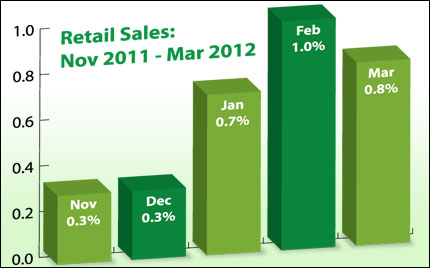
On the good side, Retail Sales in March rose by a nice 0.8%, as consumers bought all kinds of products across the board. And when stripping out autos, sales still grew. This adds to the increasing trend seen in January and February and is a good sign for our economy, as consumers don't spend when they aren't feeling optimistic about their financial situation.
"Bad news goes about in clogs, good news in stockinged feet." Welsh Proverb. And we certainly saw both good and bad news in the economic reports released last week. Here are the details...and what they mean for home loan rates.

But over in the manufacturing sector it was not as pretty a picture, as both the Empire State Manufacturing Index and the Philly Fed Index came in below expectations. This is largely being attributed to a global slowdown, and experts say that the outlook for our manufacturing remains positive…but just not accelerating at the present time. Things weren't as pretty in the housing sector either, as both Existing Home Sales and Housing Starts fell in March.

And things in the labor market were verging on ugly, as Initial Jobless Claims spiked sharply higher. The Labor Department reported 386,000 fresh Claims in the latest week, above the 375,000 that was expected...and well above the 350,000 range seen in recent weeks.

Also verging on ugly was news out of Europe. There is growing and very justified concern about Spain's ability to pay down debt, meet new budget deficit targets, and avoid a bailout or debt restructuring. The Spanish situation has prompted the G-20 (Finance Ministers and Central Bankers of the 20 largest economies) to urge the European Central Bank to do more to contain their debt crisis as it threatens global growth. And let's not forget that besides Spain, we still have France, Portugal, Ireland and Greece to deal with in future months and years.

So what does all of this mean for Bonds and home loan rates? There will likely be more safe haven trading into the relative safety of the US Dollar and US Bonds (which will benefit Mortgage Bonds, to which home loan rates are tied) as the uncertainty out of Europe escalates. And more bad economic reports here in the United States could add to this safe haven trading into our Bonds, just as more good economic news here would likely benefit Stocks at the expense of our Bonds and home loan rates.

This mix of factors will continue to impact the direction in which Bonds and home loan rates move in the weeks ahead. The takeaway is that home loan rates remain near historic lows and now continues to be a great time to purchase or refinance a home. Let me know if I can answer any questions at all for you or your clients.

Forecast For The Week: The Fed meets, plus there's news on consumer confidence, housing, the state of the economy and more.

As you can see in the chart below, the mix of news last week benefitted Bonds and home loan rates. I'll be watching closely to see what happens this week.
Chart: Fannie Mae 3.5% Mortgage Bond (Friday Apr 20, 2012)


The economic calendar this week will give the investor a broad view of the U.S. economy…but the Federal Open Market Committee (FOMC) meeting will be front and center in the minds of investors. Here's a break down of what to watch:

  • Consumer Confidence will be released on Tuesday…with Consumer Sentiment set to be delivered on Friday.
  • Also on Tuesday, New Home Sales for March will be released, followed by Pending Home Sales for March on Thursday.
  • On Wednesday, Durable Orders - which are products that are supposed to last at least three years - will be released.
  • Initial Weekly Jobless Claims will be released on Thursday. The number of new claims has been steadily rising in the past month, which is not a good sign for the labor markets. So all eyes will once again be on this report.
  • On Friday, the first reading on Gross Domestic Product (GDP) for the first quarter of 2012 will be announced.
Also on Friday, we'll see the Employment Cost Index, which measures the costs of hiring and paying the American workforce. Higher costs could lead to inflation pressures, which could push Bond prices lower and home loan rates higher.

In addition to those reports, this week's FOMC meeting will be closely watched by both the Bond and Stock markets for any clues on how the U.S. economy is holding up.

Remember: Weak economic news normally causes money to flow out of Stocks and into Bonds, helping Bonds and home loan rates improve, while strong economic news normally has the opposite result. The chart above shows Mortgage Backed Securities (MBS), which are the type of Bond that home loan rates are based on.

When you see these Bond prices moving higher, it means home loan rates are improving - and when they are moving lower, home loan rates are getting worse.

To go one step further - a red "candle" means that MBS worsened during the day, while a green "candle" means MBS improved during the day. Depending on how dramatic the changes were on any given day, this can cause rate changes throughout the day, as well as on the rate sheets we start with each morning.

Wednesday, April 18, 2012

Mortgage Market Guide Vol. 10 Issue 16

Last Week in Review: Inflation news was released...and home loan rates responded.

 "Wild thing! You make my heart sing!" The Troggs. And that song lyric is certainly an apt description for the volatility in the markets these days, as the ups and downs have given people things to both sing and scream about. Here's what happened last week...and how home loan rates were impacted.
Inflation news hit the wires, with reports on both the wholesale and consumer levels. The wholesale-measuring Producer Price Index (PPI) showed that prices remained mostly unchanged during March. Remember, inflation hurts the value of fixed investments like Bonds (including Mortgage Bonds, to which home loan rates are tied)...so the lack of inflation on the wholesale side was good news for Bonds and home loan rates. 

Also helping Bonds and home loan rates last week was the tame inflation data from the Consumer Price Index (CPI). The headline reading for March was right in line with estimates. When stripping out volatile food and energy, the Core CPI was also inline with estimates...but the year-over-year number was 2.3%, just slightly higher than the previous reading of 2.2%.  While this raises eyebrows a bit, the Fed is still reiterating that inflation remains subdued. That being said, if the Core CPI continues to rise...which is indicative of inflation and as you can see in the chart…Bonds and home loan rates will have a tough time improving much further, regardless of other factors.

One key factor to keep an eye on is the labor market, as Initial Jobless Claims increased 13,000 to 380,000 for the week ending April 7. This marks the highest level since January, and the second highest reading for 2012. The Fed has acknowledged that job creations are short of their goals. In fact, last week Federal Reserve Vice Chairman Janet Yellen said that weakness in housing, the European debt crisis, and government spending cuts are likely to slow the pace of recovery and expansion. She did state that the Fed has plenty of stimulus tools to use, if economic conditions warrant another round of quantitative easing.

The bottom line is that many factors will impact the direction in which Bonds and home loan rates move in the weeks ahead. The good news is that home loan rates remain near historic lows and now continues to be a great time to purchase or refinance a home. Let me know if I can answer any questions at all for you or your clients.

Forecast for the Week: Earnings season continues, plus look for reports on retail sales, manufacturing, housing and more.

 As you can see in the chart below, it's been a wild, volatile few weeks in the markets. I'll be monitoring all the news closely to see how the markets and home loan rates respond next.

Chart: Fannie Mae 3.5% Mortgage Bond (Friday Apr 13, 2012)


The calendar heats up this week with reports on sales, housing, jobless claims and manufacturing:
  • Right off the bat, Retail Sales will be reported on Monday - and investors will be able to gauge how consumer spending is holding up.
  • In manufacturing news, the Empire State Index out of New York and the Philadelphia Fed Index will be released on Monday and Thursday, respectively.
  • Housing will be in the news this week with Housing Starts and Building Permits for March being reported on Tuesday. Those reports will be followed by the Existing Home Sales report for March, which will be released on Thursday. 
  • The weekly Initial Jobless Claims report will be released on Thursday. The report released last week showed that jobless claims rose to their highest level since the week ending January 28. So the markets will be watching this week's release!
In addition to those reports, Corporate Earnings reports may influence the Stock markets - and as we know, the Bond markets usually move in the opposite direction.

Remember: Weak economic news normally causes money to flow out of Stocks and into Bonds, helping Bonds and home loan rates improve, while strong economic news normally has the opposite result. The chart above shows Mortgage Backed Securities (MBS), which are the type of Bond that home loan rates are based on.

When you see these Bond prices moving higher, it means home loan rates are improving - and when they are moving lower, home loan rates are getting worse.

To go one step further - a red "candle" means that MBS worsened during the day, while a green "candle" means MBS improved during the day. Depending on how dramatic the changes were on any given day, this can cause rate changes throughout the day, as well as on the rate sheets we start with each morning.

View: Have you ever needed to read an important text for work while you were driving? Now there’s an app for that.

No More Texting and Driving…There's an App for That!

A study by the National Highway Traffic Safety Administration found that distracted driving was the leading cause in nearly 450,000 accidents and more than 5,000 highway deaths.

Unfortunately, one of the most distracting elements for drivers today is text-messaging technology. The good news is that technology can also help solve this problem. Services - like Drivesafe.ly - have sprung up that eliminate the need to read text messages AND eliminate the need to respond. That's good news regardless of whether you're receiving personal or business text messages.

Here's how it works...You download an application to your phone. Then, before you get in your car to drive, you simply turn the application on. When you receive a text message, the application actually reads it to you…automatically…and out loud. So there's no need to take your eyes off the road.

Better still... the application automatically sends a reply message stating that you are driving and will respond as soon as you reach a destination that allows you to safely reply.

The application can be used on a variety of phones and there are even different plans - including a free version of DriveSafe.ly as well as family and business plans.

If you receive a lot of text messages while driving, this could be one of the most important safety steps you do this year. Take a few minutes to check it out.

After all, this simple application could save your life or the life of someone you know. 

Economic Calendar for the Week of April 16 - April 20


As your mortgage professional, I am sending you the MMG WEEKLY because I am committed to keeping you updated on the economic events that impact interest rates and how they may affect you.

Wednesday, March 7, 2012

Mortgage Market Guide Vol. 10 Issue 10

Last Week in Review: Big Ben spoke, but were his words music to the markets’ ears?

Don't fight the Fed. That popular saying last week was especially evident, as Fed Chairman Ben Bernanke's testimony on Capitol Hill had quite an impact on the markets.

Last week, Fed Chairman Ben Bernanke gave his semi-annual testimony in front of the House Financial Services Committee and his assessment of the economy, labor market and housing market was unchanged - highlighting that conditions remain sluggish, uneven and fragile. But the biggest takeaway was that he made no mention of another round of Bond buying or Quantitative Easing (QE3).

This clearly disappointed virtually all the markets as both Bonds and Stocks closed lower the day he spoke. So here's an important question to ask: Is the economy strong enough to keep the Fed from pumping any more money (QE3) into the economy? While the economy has improved on many fronts, it is still fragile and it would not take much for growth to slow...meaning more Fed intervention would be needed. For instance, high oil prices, a worsening situation in Europe or China, and escalating concerns in Iran could all cause our economy to slow.
One thing is for sure - the incoming economic data over the next couple weeks and months will be very important to follow for signs of continued economic improvement or potential slowing. One important factor to note from last week: inflation, as measured by the Core Personal Consumption Expenditure (PCE), rose by 0.2% in January, while the year-over-year Core PCE climbed to 1.9% and just beneath the Fed's upper target of 2%. Seeing inflation rise, even though the Fed continues to say it is moderating, is a concern. With Core PCE just beneath the Fed's desired target, upcoming readings will play an important role in how long the Fed continues its accommodative policy and any chance of more easing, QE3.

The most important thing to take away is that home loan rates still remain near historic lows, and now continues to be a great time to purchase or refinance a home. Let me know if I can answer any questions at all for you or your clients.

Forecast for the Week: The Jobs Report for February will be released on Friday; plus news on productivity and the service sector.

As you can see in the chart below, it was a volatile week in the markets, though Bonds and home loan rates were able to rebound late in the week. I'll continue to monitor this situation closely.

Chart: Fannie Mae 3.5% Mortgage Bond (Friday Mar 02, 2012)


Several important economic reports will be released this week, especially Friday's Jobs Report for February.
  • The ISM Services Index will be released on Monday. This report comes after the weaker-than-expected ISM Manufacturing Index last week, so the markets will be watching it closely. After all, the service sector makes up about 70% of the U.S. job market!
  • The private ADP Employment Report will be delivered on Wednesday.
  • Another important report this week will be the Productivity Report on Wednesday. This report measures the number of hours it takes to produce a good in a factory. In the service sector, it is measured based on the revenue generated by an employee divided by one's salary.
  • As usual, Initial Jobless Claims will be released on Thursday. The number of Americans claiming first-time benefits has dropped in the past few months. Will the trend continue? We'll find out Thursday.
  • Last but not least is Friday's closely watched monthly official Jobs Report. January's report showed that 243,000 new jobs were created. This is a blockbuster report that always has the potential to move the markets!
Remember: Weak economic news normally causes money to flow out of Stocks and into Bonds, helping Bonds and home loan rates improve, while strong economic news normally has the opposite result. The chart above shows Mortgage Backed Securities (MBS), which are the type of Bond that home loan rates are based on.

When you see these Bond prices moving higher, it means home loan rates are improving - and when they are moving lower, home loan rates are getting worse.

To go one step further - a red "candle" means that MBS worsened during the day, while a green "candle" means MBS improved during the day. Depending on how dramatic the changes were on any given day, this can cause late changes throughout the day, as well as on the rate sheets we start with each morning. 

View: Before you visit another web page, read the important article below about protecting your information online.

Protect Your Passwords, Accounts, Searches and Emails

Search engines make life easier. We've become so accustom to simply typing in a few words and hitting "search" that we don't even realize how much data is being generated with every click…or what that data says about us. Last week, however, this topic was forced front and center.

What Happened Last Week?

Google's new privacy policy went into effect last week. Based on the new policy, all data collected about you - including search queries, sites visited, age, gender and location - will be gathered and assigned to your online identity represented by your Gmail, Google Plus, and YouTube accounts.

Prior to that, information about your Google searches and sites visited was kept separate from Google's other products. The wall between those products has now been removed and more of your information than ever is potentially floating around in cyberspace.

All of this provides a good reason to revisit your privacy settings and your own habits when searching information or conducting business online.

Why Does It Matter?

The history stored in a browser can contain sensitive information, such as your phone number, account numbers, passwords, emails, and so on.

In addition, your search queries can also reveal information about you, including private information like health concerns. In fact, privacy experts have raised concerns about that type of information being gathered in the event that it may be used when you apply for credit, a new job, car or life insurance, and even health care coverage.

Finally, if you work in a business where you help people with private financial matters (such as purchasing a home, improving their credit score, and so on), the need for privacy is even greater.

The Good News Is…

The first piece of good news is that major companies such as Microsoft, Google, and AOL recently agreed to install a do-not-track button in Web browsers to make sure that you can browse the Internet with more privacy. But it'll take a while before this button actually arrives in a browser near you.

The second piece of good news is that you already have a simple step that you can use in the meantime to help keep sensitive information from being recorded.

Tell Your Clients, Business Partners, and Friends…

Most browsers already feature a privacy setting that can be turned on. When you activate the private browsing setting, the actions you take are kept private - which means caches, browser history, forms, passwords and other temporary files are not permanently recorded. Instead, once the window is closed, the data is erased. So you can feel more comfortable working online without worrying that bank balances, emails, or passwords are being captured.

This is especially important if you use a shared computer in a business setting or a public computer (such as a computer at a public library or Internet café).

PCWorld recently provided the following quick instructions for setting your browser to privacy mode:
  • Internet Explorer 9: Ctrl-Shift-P
  • Chrome: Ctrl-Shift-N
  • Firefox: Ctrl-Shift-P
  • Safari: Go to the "Edit" menu and choose "Private Browsing"
But Don't Forget!

Even if you use a privacy setting, you'll need to quit a browser when you're done. That's because the "back" button still works in privacy mode, so someone else could easily click back to previously viewed pages, such as an email or financial account if you step away.

Finally, remind your clients and friends that social media sites may ask for a lot of information, but that doesn't mean you should share it. Phone numbers, your full date of birth, and social security numbers should never be part of your profile.

Following those simple steps can help you feel more comfortable about working online, especially when sensitive information is on the line.